
Last Updated: October 23, 2026
Quick Summary
Energy saving window film is a thin, professionally applied layer that rejects solar heat at the pane before your air conditioner sees it, lowering cooling costs. Spectrally selective ceramic film is the best choice for heat reduction because it rejects solar heat while keeping visible light transmission high.
- Dyed film absorbs heat cheaply, but absorbed heat re-radiates inward and performance fades over time.
- Ask for published performance data: solar heat gain coefficient, visible light transmission, and U-factor.
- Run savings calculations one elevation at a time, since a single west-facing wall can carry a disproportionate cooling load.
- Payback period is total installed cost divided by annual energy savings.
- Clean film with a soft cloth and mild, ammonia-free cleaner, skipping abrasive pads and razor blades.
Table of Contents
- How Window Film Improves Energy Efficiency
- Best Window Film for Heat Reduction
- Commercial Energy-Saving Window Film: What Property Managers Should Know
- Using a Window Film Energy Savings Calculator
- Window Film Cost and Payback: What to Expect
- Matching Window Film to Glass, Climate, and Orientation
- Installation, Care, and How Long Window Film Lasts
- Conclusion
- Frequently Asked Questions
How Window Film Improves Energy Efficiency
Energy saving window film is a thin, professionally applied layer that changes how glass handles solar energy, rejecting heat at the pane before your air conditioner ever sees it. At Outlaw Kustomz, we install window tinting for homes and commercial buildings across the Tulsa area, and the question we hear most is simple: does it actually lower the bill?
Sunlight strikes glass and splits three ways: some reflects away, some passes through as visible light, and some is absorbed and re-radiated as heat. Film adjusts those proportions.
- Solar heat gain drops because the film reflects and absorbs more of the sun’s energy before it crosses into the room.
- Glare reduction follows the same principle, cutting the harsh light that forces you to close blinds and lose your daylight.
- UV protection blocks the ultraviolet rays that fade flooring, artwork, and furniture upholstery.
The trade-off: a darker film also cuts visible light transmission, so a room can feel dimmer at midday. That is why film selection matters more than film brand.
Best Window Film for Heat Reduction
The best window film for heat reduction is a spectrally selective heat-control film, which rejects solar heat while keeping visible light transmission high enough that you do not need lamps at noon.
What separates the categories:
- Dyed film absorbs heat cheaply, but absorbed heat re-radiates inward, so performance fades over time.
- Metallized film reflects well but can interfere with cell and Wi-Fi signals and reads as mirror-like from outside.
- Ceramic film uses non-conductive particles to reject solar heat without the metallic look or signal issues.
Low-emissivity film is a separate tool: where heat-control film manages incoming sun during cooling season, low-emissivity film manages outgoing heat during heating season by lowering the glass’s U-factor.
Ask for the film’s published performance data before you commit: solar heat gain coefficient, visible light transmission, and U-factor. A reputable installer will hand you the manufacturer spec sheet without being asked twice.
Commercial Energy-Saving Window Film: What Property Managers Should Know
Commercial energy-saving window film is where the math gets interesting, because a property manager is buying against a whole building’s cooling load rather than one room’s comfort. Large glass facades on offices, retail fronts, and warehouses absorb enormous solar gain, and the air conditioning pays for it all afternoon.
Three things property managers should weigh before signing off:
- Tenant comfort and complaints. West- and south-facing suites overheat first. Film on those elevations alone often resolves the worst complaints.
- Security laminate. Many commercial films add glass-breakage protection, which pairs naturally with heat rejection and can matter for insurance and safety reviews.
- Glass compatibility. Some sealed insulating glass units and certain tinted or low-E glass types carry thermal stress risk when filmed. Skipping this check is how a cheap project becomes an expensive one.
We handle commercial tinting through our climate-controlled facility. That control matters: dust and temperature swings during application are the usual causes of premature film failure.
Using a Window Film Energy Savings Calculator
A window film energy savings calculator estimates annual savings by combining your glass area, climate zone, utility rate, and the film’s published performance values. Treat the output as a planning range, not a promise, and understand the mechanics well enough to spot an inflated estimate.
The inputs that actually drive the result
Most calculators ask for the same inputs, but not all weight them the same way:
- Square footage of glass, separated by orientation. South, west, east, and north glass receive different solar loads, and a calculator that averages them will mislead you.
- Local electricity rate per kilowatt-hour. Use the marginal rate that applies during cooling hours, not a blended annual average.
- The film’s solar heat gain coefficient (SHGC) and U-factor. SHGC governs how much solar heat crosses the glass; U-factor governs conductive heat flow. Both come from the manufacturer’s spec sheet.
How the calculation actually works
The calculator runs a chain of conversions:
- Solar load reduction. Existing glass SHGC minus filmed SHGC gives the fraction of solar heat rejected. Multiply by the solar load on that orientation to estimate the heat no longer entering the room.
- Cooling electricity saved. Divide the reduced cooling load by your air conditioner’s efficiency rating to convert heat into kilowatt-hours, then multiply by your electricity rate.
- Heating-season effect. Low-emissivity film lowers the U-factor, reducing heat loss in winter. The savings are usually smaller than summer cooling savings in most climates, but they are real in a mixed or cold climate.
- Annual total. Sum the cooling and heating savings, then divide total installed cost by that annual figure to get payback.
Run the numbers one elevation at a time. A single west-facing wall can carry a disproportionate share of the cooling load, and averaging the whole building hides that.
Manufacturer claims versus independently tested values
Performance numbers come from two places:
- Manufacturer-published values are the numbers on the spec sheet. They are the starting point for any calculation, but they are self-reported.
- Independently tested values come from accredited laboratories using standardized test methods. When a film has been tested independently, the results are the ones to trust for a payback estimate.
Ask which values the calculator uses. One built on manufacturer claims produces a rosier number than one built on independent test data, and the gap can change the payback conclusion.
Before you trust any calculator output, confirm three things: the SHGC and U-factor match the exact product being quoted, the electricity rate is your own marginal rate, and the glass area is measured by orientation rather than estimated from floor plan square footage.
Climate and orientation change the answer
The same film on the same square footage saves very differently depending on orientation and climate:
- Hot-summer climates. Cooling savings dominate. Prioritize low SHGC on west and south glass, and expect the shortest payback.
- Mixed climates with a real heating season. A film that also lowers U-factor pays twice, once in summer and once in winter. The heating-season contribution is smaller but meaningful.
- Cold climates. Heating-season savings from low-emissivity film matter more, but cooling savings shrink. Payback stretches out.
The U.S. Department of Energy guidance on window attachments explains how solar heat gain and U-factor drive a window’s overall performance, which is the foundation every calculator builds on. The ENERGY STAR window performance resources are useful for comparing your existing glass against efficient alternatives.
Use the calculator to rank elevations, not to predict a precise dollar figure. The wall with the highest calculated savings per dollar of film is almost always the right place to start, and one well-chosen wall often delivers more comfort improvement than filming the entire building with a compromise product.
Window Film Cost and Payback: What to Expect
Window film cost and payback depend on glass area, film grade, access difficulty, and whether the job is residential or commercial, so a responsible quote follows a walkthrough rather than a phone call. Anyone handing you a firm number before seeing the glass is guessing. A good guide shows the cost drivers, the payback math, and how film stacks up against the alternatives, so you can sanity-check any quote.
What drives the installed cost
Four variables move the price more than anything else:
- Glass area and pane count. Film is priced per square foot of glass, and a whole-house job has a lower per-square-foot rate than a single room because setup and travel are spread across more panes.
- Film grade. A basic dyed or metallized film sits at the low end; a spectrally selective ceramic or low-emissivity film sits at the high end. The performance gap between grades is real, and so is the price gap.
- Access and prep. Second-story windows, skylights, curved glass, and heavily soiled panes add labor. So does moving furniture and protecting floors.
Installed residential pricing typically lands in a broad per-square-foot band, with ceramic and low-E products at the top and basic films at the bottom. Commercial pricing is usually quoted per project because facade area and access dominate. Ask any installer to break the quote into film, labor, and prep so you can compare bids on the same basis.
The payback formula, worked through
The payback period is total installed cost divided by annual energy savings. The hard part is the denominator, where most estimates go wrong.
A defensible estimate follows this sequence:
- Measure glass area by orientation. South, west, east, and north glass behave differently, and averaging them hides the wall that is actually driving your cooling load.
- Pull twelve months of utility bills. Use your own kilowatt-hour consumption and your own rate, not a national average. If your rate has tiers or time-of-use pricing, use the marginal rate that applies during cooling hours.
- Get the film’s published performance values. Solar heat gain coefficient (SHGC) and U-factor are the two numbers that matter for energy, and visible light transmission (VLT) tells you how dark the room will get.
- Estimate the change in solar gain. The difference between your existing glass’s SHGC and the filmed SHGC, multiplied by the solar load on that orientation, gives a rough reduction in heat entering the space.
- Convert heat reduction to kilowatt-hours. Divide the reduced cooling load by your air conditioner’s efficiency (its SEER2 rating) to get the electricity saved, then multiply by your rate.
- Add the heating-season effect separately. Low-emissivity film lowers the glass U-factor, which reduces heat loss in winter, but the savings are usually smaller than summer cooling savings in most of the country.
Run that sequence one elevation at a time. A single west-facing wall can carry a disproportionate share of the afternoon cooling load, and a whole-building average understates what film on that wall returns.
Ask your installer for the manufacturer’s spec sheet showing SHGC, U-factor, and VLT for the exact product being quoted. A reputable installer will hand it over without being asked twice, and it is the only way to compare bids on performance rather than price alone.
Film versus the alternatives
Film is not the only way to cut window-driven energy loss, and an honest payback comparison puts it against the alternatives:
- Weatherstripping and air sealing are the cheapest first step and address infiltration, not solar gain. Do this before filming.
- Cellular shades add insulation and control glare, but they block daylight and require operation. Film is permanent and maintenance-free by comparison.
- Storm windows improve U-factor on single-pane glass but do nothing for solar heat gain and change the look of the house.
The right comparison depends on your glass. On failing or single-pane units, replacement often wins on performance. On sound double-pane glass that is simply too hot, film usually wins on cost and speed.
Rebates and incentives
Utility and government incentive programs change frequently and vary by provider, so check with your utility and state energy office before assuming any credit applies. Ask specifically whether the program covers window film or only window replacement, because many efficiency programs are written around replacement. Keep the manufacturer spec sheet and your invoice; most rebate applications require both.
The most common mistake we see is comparing film against the wrong baseline. Film is priced against doing nothing, but it should also be weighed against window replacement, solar screens, and exterior shading. On older single-pane glass, replacement often wins on raw performance while film wins on cost and disruption.
Getting a quote you can trust
A good quote names the film product and its SHGC, U-factor, and VLT; separates film, labor, and prep; states the warranty terms and who honors them; and confirms a glass-compatibility check was performed. If a bid is missing any of those, ask before you sign. The payback number is only as honest as the inputs behind it.
Matching Window Film to Glass, Climate, and Orientation
Film selection should follow the glass, the climate, and the compass, in that order.
Orientation drives the recommendation. South-facing glass takes steady sun through the day and benefits from balanced heat-control film.
Climate sets the target. In a hot-summer climate, prioritize solar heat rejection. In a mixed climate with a real heating season, a film that also improves insulation pays twice.
Match film to the elevation with the worst comfort problem first. One well-chosen wall often delivers more comfort improvement than filming the entire building with a compromise product.
Installation, Care, and How Long Window Film Lasts
Professional installation, proper cleaning, and a quality film determine how long window film lasts, and most well-installed residential film runs for many years before showing wear.
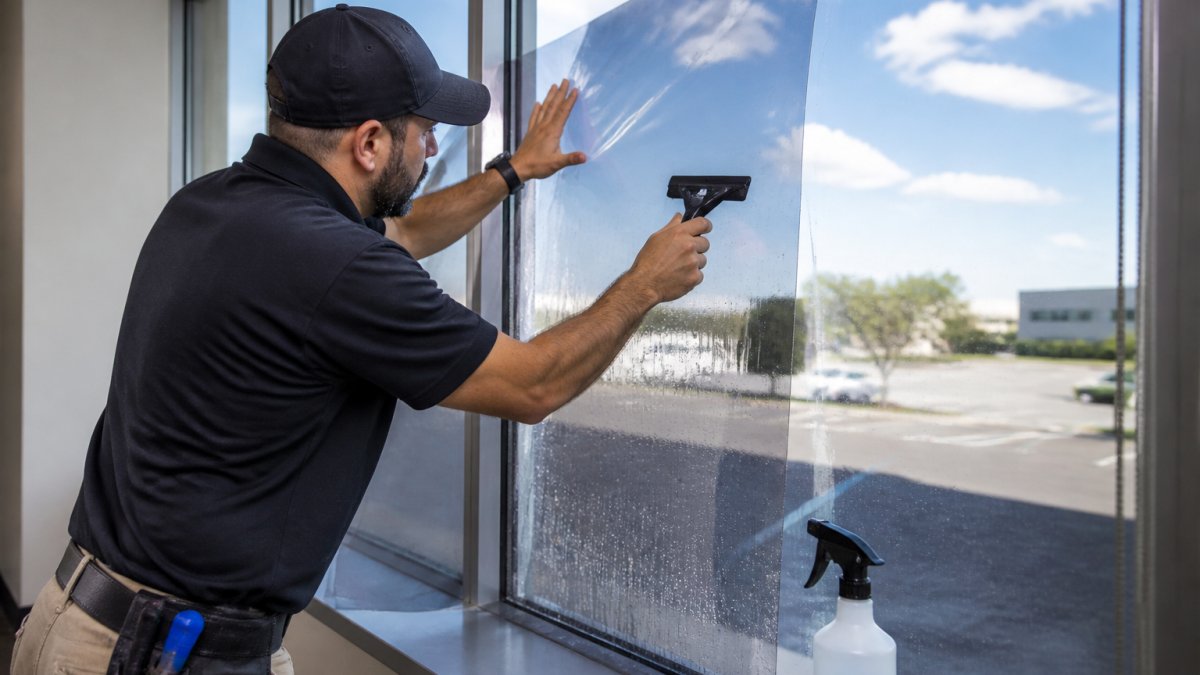
Installation matters because film is unforgiving. Dust trapped under the sheet, air bubbles, and temperature swings during curing all shorten its life.
Care is simple:
- Wait through the manufacturer’s curing window before the first wash.
- Clean with a soft cloth and a mild, ammonia-free cleaner.
- Skip abrasive pads and razor blades on the film surface.
DIY installation is possible on small, flat panes, but on large commercial glass or curved surfaces the risk of a failed sheet outweighs the material savings.
Conclusion
The gap between a film that pays for itself and one that disappoints comes down to three decisions: matching the film to your glass type, choosing the right elevation, and getting the installation conditions right. Most buyers focus only on the film itself and skip the other two.
If you want the numbers before you commit, our team at Outlaw Kustomz will walk your glass, check compatibility, and quote the job properly. We bring decades of combined installation experience, a climate-controlled facility, and manufacturer-backed warranties through Arlon, 3M, and Oracle.
Frequently Asked Questions
Does energy-saving window film really reduce energy costs?
It can, but the amount depends on your glass, climate, and how much sun the windows get. Window film lowers solar heat gain and reduces UV exposure, which eases the load on air conditioning during the cooling season. Savings are largest on west- and south-facing single-pane or clear double-pane glass in hot climates. Treat any savings claim as an estimate until you model it for your specific building, and ask for documented film performance data before you buy.
What type of window film is best for heat reduction?
For pure heat rejection, spectrally selective and low-emissivity films usually outperform dark dyed films. Look at solar heat gain coefficient (SHGC), total solar transmittance, and visible light transmission together. A low SHGC with a visible light transmission above 50% keeps rooms bright while blocking heat. Ceramic-based films are a common choice for homes and offices because they reject heat without a heavy dark tint. Your installer should match the film to your glass type and sun exposure.
Can window film help keep a building warm in winter?
Yes, low-emissivity (low-E) films can help during the heating season by reducing radiant heat loss through the glass. Standard heat-control films do less for winter performance because their main job is rejecting incoming solar heat. If winter comfort and heat loss matter as much as summer heat, ask specifically for a low-E film and check its U-factor rating. In mixed climates, a film that balances both SHGC and U-factor is usually the better long-term pick.
How much can commercial window film reduce cooling costs?
There is no single number. Cooling savings depend on window area, glass type, building orientation, local utility rates, and HVAC efficiency. A west-facing wall of single-pane glass in a hot climate will show far more impact than a shaded north-facing wall of low-E glass. Use a window film energy savings calculator with your actual square footage and utility rate to get a defensible estimate, then compare that against installed cost to see a realistic payback period.
How long does energy-saving window film last?
Most quality architectural films carry manufacturer warranties in the 10 to 15 year range, and many last longer when professionally installed and properly cleaned. Lifespan depends on film quality, sun exposure, glass type, and installation method. Films on intense west-facing glass age faster than films on shaded windows. Avoid abrasive cleaners and ammonia-based products, which degrade the film surface. Ask for the written manufacturer warranty before you commit.
Can window film be installed on existing commercial windows?
In most cases, yes. Film is applied directly to existing glass, so there is no window replacement and minimal disruption to tenants. The main exception is certain sealed insulating glass units, where the wrong film can increase thermal stress and risk cracking or seal failure. A professional installer will check your glass type, tint, and framing before recommending a film. That inspection step is what separates a durable installation from a failed one.
