
Last Updated: October 25, 2026
Quick Summary
The best paint protection for trucks matches the material to how the truck is used: paint protection film for impact zones and ceramic coating for UV, staining, and easy cleaning. Work trucks and off-road rigs should prioritize film on high-impact areas first, then add a ceramic topcoat.
- Paint protection film physically absorbs rock chips and scratches, while ceramic coating repels water and contaminants.
- Professionally installed film lasts roughly five to ten years depending on grade, sun exposure, and washing.
- Partial front-end film covers bumper, hood leading edge, mirror caps, and A-pillars at lower cost.
- Ceramic coating is microns thin and will not stop rock chips or branch scratches.
- Ask installers to quote prep, material, labor, and topcoat separately for fair comparisons.
Table of Contents
- Start With How Your Truck Actually Gets Used
- Paint Protection Film vs Ceramic Coating: What Each One Does
- Truck Rock Chip Protection: Where Film Earns Its Keep
- How Long Does PPF Last on a Truck?
- Truck Paint Protection Cost: What Drives the Price
- Protection for Work Trucks, Off-Road Use, and the Bed
- Book a Paint Protection Assessment for Your Truck
- Frequently Asked Questions
Start With How Your Truck Actually Gets Used
The best paint protection for trucks depends less on the product label and more on where your truck spends its miles. A daily driver that commutes on the highway faces a different threat profile than a work truck that hauls gravel and trailers down county roads.
At Outlaw Kustomz, we start every protection conversation with that question, not with a product pitch. Gravel trucks need impact defense on the front end. Show trucks need gloss and UV resistance. Off-road rigs need both, plus coverage that survives brush and trail debris.
Paint protection is any film, coating, or wax layer applied over your truck’s clear coat to absorb damage before it reaches the paint. The right choice matches the material to the abuse. Below, we break down each option by use case, durability, and cost so you can decide with confidence.
Paint Protection Film vs Ceramic Coating: What Each One Does
Paint protection film and ceramic coating solve different problems, and most truck owners eventually want both. PPF is a thick, clear urethane film that physically absorbs rock chips, scratches, and road debris. Ceramic coating is a liquid polymer that bonds to the paint and adds a hydrophobic layer that repels water and contaminants.
Film protects against impact. Coating protects against everything else: UV rays, bird droppings, tree sap, and staining. For a deeper comparison of durability and lifespan, read our breakdown of paint protection film vs ceramic coating.
A common mistake is expecting ceramic coating to stop rock chips. It will not. The coating is microns thin, so a gravel strike still reaches the paint. Film takes the hit instead.
Truck Rock Chip Protection: Where Film Earns Its Keep
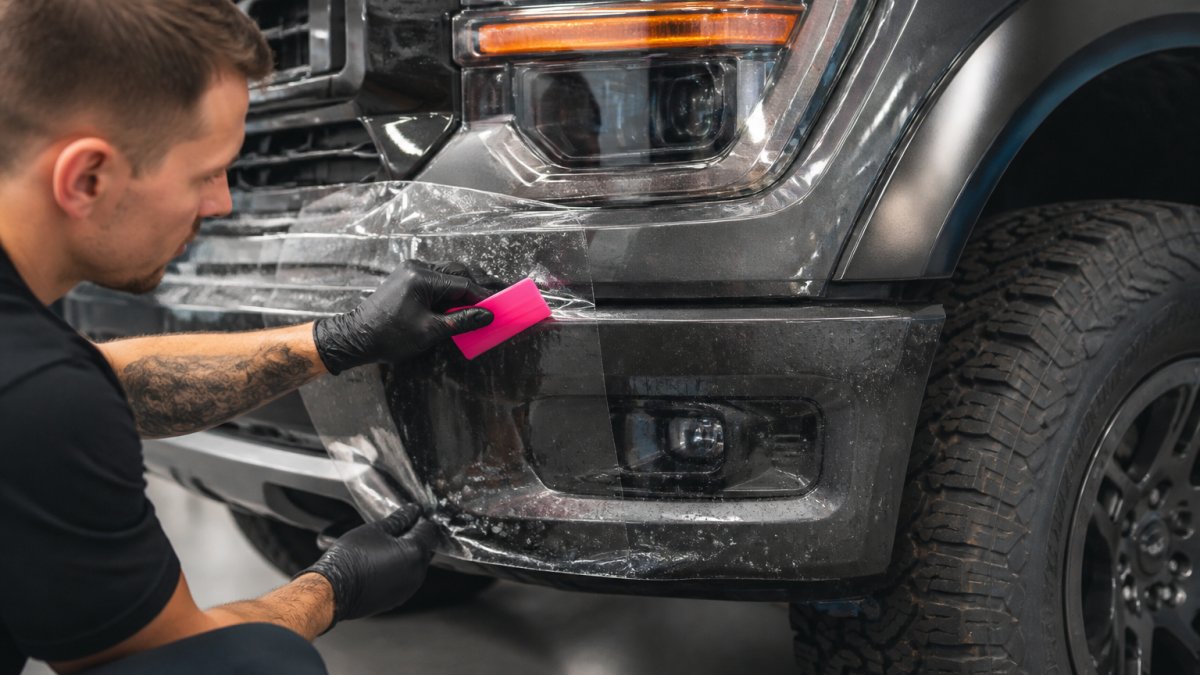
Rock chip protection is where film pays for itself fastest on a truck. The front bumper, hood leading edge, mirror caps, A-pillars, and rocker panels catch the most debris, and those are the panels that chip first.
Partial coverage handles the high-impact zones at a lower cost. Full-body coverage protects every painted panel, which matters more on dark colors where chips show white against the paint.
Trucks sit higher and present more frontal area than cars, so they collect more road debris at speed. That geometry alone makes film a stronger value on a truck than on a sedan.
How Long Does PPF Last on a Truck?
Expect a professionally installed paint protection film to last roughly five to ten years, depending on film grade, sun exposure, and how you wash it. Top-tier films from manufacturers like 3M and Arlon carry multi-year warranties, and installation quality decides whether the film reaches that ceiling.
Watch out: cheap film or rushed installation leads to yellowing, peeling edges, and lifting corners within a couple of years. That is the failure most truck owners describe when they say their last film job did not hold up.
Care matters too. Hand washing with pH-neutral soap and skipping automated brushes will extend film life considerably. So will parking out of direct afternoon sun where possible.
Truck Paint Protection Cost: What Drives the Price
Truck paint protection cost depends on coverage area, film grade, paint condition, and installation complexity, so a quote for one truck rarely matches another. The fastest way to compare quotes is to separate the job into four line items: prep, material, labor, and topcoat.
Prep. Paint correction, decontamination, and panel removal are labor, not product. A truck with existing chips, swirls, or scratches needs correction before film or coating goes on, because film locks in whatever is underneath it. Skipping prep is the most common reason a cheap quote looks cheap.
Material. Film is priced per square foot and by grade. Entry-level film costs less per panel but tends to yellow, peel at edges, and lift at corners sooner. Premium films from manufacturers like 3M and Arlon carry multi-year warranties and cost more per panel, but they are the ones that reach the five-to-ten-year lifespan. Ceramic coatings are priced by the kit and by the coating tier, from consumer-grade sprays to professional multi-layer coatings.
Labor. Large, curved panels take longer to install cleanly than flat ones. A hood leading edge is quick; a full bumper with sensors, tow hooks, and complex curves is not. Full-body film on a crew-cab pickup is a multi-day job, and labor is usually the largest line item.
Topcoat. Ceramic coating over film is an add-on, not a substitute. It adds hydrophobicity and easier washing but does not add impact protection.
As a planning framework, most shops quote partial front-end film (bumper, hood leading edge, mirror caps, A-pillars) at the low end, full-body film at the high end, and ceramic coating alone below both. Treat any quote as a range until the installer has seen the paint in person. For a benchmark on related truck work, our cost of custom truck wraps guide walks through the same pricing drivers: coverage, prep, and installation complexity.
| Protection Option | Best For | Impact Protection | Lasts (Typical) | Upkeep |
|---|---|---|---|---|
| Carnauba wax | Show trucks, short-term gloss | None | Weeks to a few months | Reapply often |
| Polymer paint sealant | Daily drivers on a budget | None | Several months | Reapply seasonally |
| Ceramic coating | UV, staining, water beading | None | Years with care | Hand wash only |
| Partial PPF | Highway commuters, leased trucks | High on covered zones | Five to ten years | Hand wash only |
| Full-body PPF | Work trucks, off-road, long ownership | High on all panels | Five to ten years | Hand wash only |
Ask every installer to quote prep, material, labor, and topcoat separately. A quote that bundles them hides where the money goes and makes it hard to compare two shops fairly.
Budget and ownership period should drive the decision more than the product label. If you plan to keep the truck fewer than three years, partial front-end film plus a sealant is usually the sensible spend. If you plan to keep it five years or more, full-body film plus a ceramic topcoat spreads the cost over the ownership period and protects resale value. If the truck is a work truck that sees gravel and job sites daily, prioritize film on the high-impact zones first and add coating later.
Protection for Work Trucks, Off-Road Use, and the Bed
Work trucks and off-road rigs need a different plan than a pavement-only daily driver. Gravel dust, trailer hitches, tool boxes, and trail brush all attack paint in ways highway driving does not. The gap most protection guides leave open is that they treat a truck like a passenger car. A truck has its own high-impact zones, and each one fails differently.
Front end. The bumper, hood leading edge, grille surround, and mirror caps take the first hit from road debris and gravel. This is where partial film earns its keep fastest.
Rocker panels and wheel arches. Tires throw gravel and mud backward along the rockers, and wide tires on lifted trucks throw it higher. Film on the rockers and the leading edge of the rear wheel arches prevents the sandblasted look that shows up first on darker paint.
Bed sides and tailgate. Loading and unloading, tool boxes, and trailer hitches abrade the bed sides and tailgate more than the road does. Film on the bed sides and the top of the tailgate protects the painted surfaces that cargo actually touches.
Bed floor. This is a separate decision from exterior paint protection. A spray-in liner or a bed mat handles cargo abuse, impact, and sliding loads. Bed film is thinner and protects paint from abrasion but will not stand up to dropped tools or sharp cargo the way a liner will. Use a liner or mat for the bed floor and film or coating for the painted surfaces around it. Do not skip the bed sides, because that is where most work-truck paint damage starts.
Off-road exposure. Brush, branches, and trail debris scratch along the sides and roof line. Film handles light branch scratches better than coating, which is microns thin and offers no impact resistance. Coating on top of film makes mud and dust wash off easier after a long week, which matters if the truck sees mud regularly.
Ceramic coating alone will not stop rock chips, branch scratches, or cargo abrasion. If the truck sees gravel, job sites, or trails, film is the impact layer and coating is the easy-clean layer on top.
Match the plan to the exposure. A pavement-only daily driver can get by with partial front film and a sealant. A truck that tows and hauls on gravel roads should add rocker and bed-side film. A truck that sees job sites and trails regularly should plan for broader film coverage plus a ceramic topcoat, and should expect to hand wash rather than run it through brushes. To see how protection and graphics come together on real pickups, view our work.
Book a Paint Protection Assessment for Your Truck
Choosing the best paint protection for trucks comes down to three questions: how you drive, how long you plan to keep the truck, and what your budget allows. Answer those honestly and the right combination of film and coating becomes obvious.
Our team at Outlaw Kustomz installs computer-cut paint protection kits tailored to your truck’s exact make and model inside an 8,000 sq. ft. climate-controlled facility. We back the work with strong manufacturer warranties through our partnerships with 3M, Arlon, and Oracle. You can see our full range of services or contact us for a free estimate.
Frequently Asked Questions
Which is better for a truck, paint protection film or ceramic coating?
They solve different problems. Paint protection film absorbs impacts from rock chips and road debris, so it belongs on the front bumper, hood, mirrors, and rocker panels. Ceramic coating adds a hydrophobic layer that makes washing easier and helps block UV rays, but it will not stop a stone. Many truck owners combine both: film on the high-impact zones, coating over the rest of the paint and over the film itself for easier upkeep.
Does paint protection film prevent rock chips on trucks?
Yes. Paint protection film is the only option in this comparison built to absorb impact. A quality film takes the hit from gravel, road debris, and bug splatter so the clear coat underneath stays intact. Coverage matters: a partial kit on the hood and bumper handles most highway damage, while full-body coverage protects doors and bedsides from parking lot dings and trail spray.
How long does PPF last on a truck?
Most quality films carry manufacturer warranties in the five-to-ten-year range, and actual lifespan depends on sun exposure, washing habits, and whether the truck parks outside. Film on a garage-kept truck typically outlasts film on a work truck that sits in the sun daily. Ask about the specific warranty terms in writing, and have the film inspected during annual maintenance.
Is paint protection worth it for a work truck?
For a truck that racks up highway miles or runs off-road, yes. Repainting a hood or bumper costs far more than a partial film kit, and a work truck with intact paint holds resale value and looks better carrying your company graphics. If the truck is a low-mileage garage queen, a ceramic coating and disciplined washing may be enough.
Your truck’s paint is only original once, and every chip is permanent until someone repaints the panel. Get ahead of it with a professional assessment before the damage starts. Get started with Outlaw Kustomz and protect the finish that protects your truck’s value. Call (918) 810-3929 today.
