
Last Updated: November 2, 2026
Quick Summary
Fleet graphics are vinyl lettering, decals, and partial or full wraps applied to commercial vehicles so they advertise your business while driving normal routes. For small businesses, they turn every trip to a job site into mobile advertising that runs without a media budget.
- Fleet graphics cover part of the vehicle, while full wraps cover the entire painted surface.
- Design for legibility first: readable at 20 feet and moving, with high contrast and clean layouts.
- Build attribution into the design using a dedicated tracking number, a QR code or short URL, and an intake question.
- Record average monthly calls, form submissions, and booked jobs for two to three months before installation as a baseline.
- Before installation, check state and municipal signage rules, lease or financing restrictions, and notify your insurer.
Table of Contents
- Why Fleet Graphics Make Sense for Small Businesses
- Fleet Graphics vs. Full Vehicle Wraps: Which Fits Your Budget
- What Commercial Vehicle Graphics Cost and What Drives the Price
- Fleet Wrap Design Ideas That Work on Real Vehicles
- How to Read Fleet Branding ROI Without Guesswork
- Commercial Vehicle Wrap Lifespan and What Shortens It
- Permits, Leases, and Insurance Rules to Check First
- Getting Your Fleet Graphics Quote from Outlaw Kustomz
- Frequently Asked Questions
Why Fleet Graphics Make Sense for Small Businesses
Fleet graphics are vinyl lettering, decals, and partial or full wraps applied to commercial vehicles so they advertise a business while driving normal routes.
Paid ads stop the moment you stop paying.
At Outlaw Kustomz, we build these programs for tradespeople, service companies, and mixed fleets.
Three reasons it works so well for small operations:
- Cost efficiency. One installation serves the vehicle’s whole service life, not a campaign window.
- Local targeting. Your trucks drive the exact neighborhoods and commercial corridors where your customers are.
- Trust by repetition. A clean, consistent vehicle reads as an established business, and customers notice.
Watch out: the most common mistake is treating graphics as decoration.
If you want to see what a branded fleet program actually involves, explore our fleet lettering and graphics service and get a straight answer on scope.
Fleet Graphics vs. Full Vehicle Wraps: Which Fits Your Budget
Fleet graphics cover part of the vehicle; full wraps cover the entire painted surface.
Fleet graphics typically means computer-cut vinyl lettering, logo decals, and door or panel graphics. Coverage is partial by design.
Full vehicle wraps cover the body panels edge to edge with printed vinyl.
Here’s the honest trade-off:
| Option | Coverage | Best For | Main Drawback |
|---|---|---|---|
| Fleet graphics / lettering | Partial panels | Trades, service fleets, tight budgets | Less visual impact at distance |
| Partial wrap | Doors, rear, one side | Growing businesses wanting more presence | Design must work around paint |
| Full wrap | Entire body | Delivery fleets, brand-forward companies | Highest material and install cost |
Where most guides get it wrong is pushing full wraps at every small business.
If you’re weighing the lower-cost route, look at our custom partial vehicle wrap option for cars, trucks, and vans.
What Commercial Vehicle Graphics Cost and What Drives the Price
Commercial vehicle graphics cost varies widely because pricing depends on vehicle size, coverage area, material grade, design complexity, and installation labor.
The three coverage tiers. A lettering package (company name, logo, phone number, and a service line on doors and rear panels) is the entry tier. A partial wrap adds printed color and graphics across the doors, rear, and one or both sides while leaving part of the paint exposed. A full wrap covers every painted panel edge to edge.
What actually moves your quote:
- Vehicle size and shape. A compact cargo van has far less surface area than a box truck, and deep curves, rivets, and textured panels add install hours.
- Coverage level. Lettering is the least expensive; full coverage is the most. Partial wraps sit in between and are usually the best value for a service fleet.
- Material quality. Cast vinyl with a quality laminate costs more upfront and lasts longer. Calendared film saves money now and tends to shrink and lift at edges later.
- Design work. If you need graphics designed from scratch, that is a line item. If you have print-ready vector artwork, it is not.
- Installation complexity. Removal of old graphics, window perforation, and wrap-over seams all add labor.
Where the money goes. Material and installation dominate the quote; design is usually the smallest line.
Watch out: the cheapest quote is rarely the cheapest outcome.
For a detailed breakdown of the factors behind a quote, read our guide to what drives the price of custom vehicle graphics.
Fleet Wrap Design Ideas That Work on Real Vehicles
Good fleet wrap design ideas all share one trait: they’re readable at 20 feet and moving. Everything else is secondary.
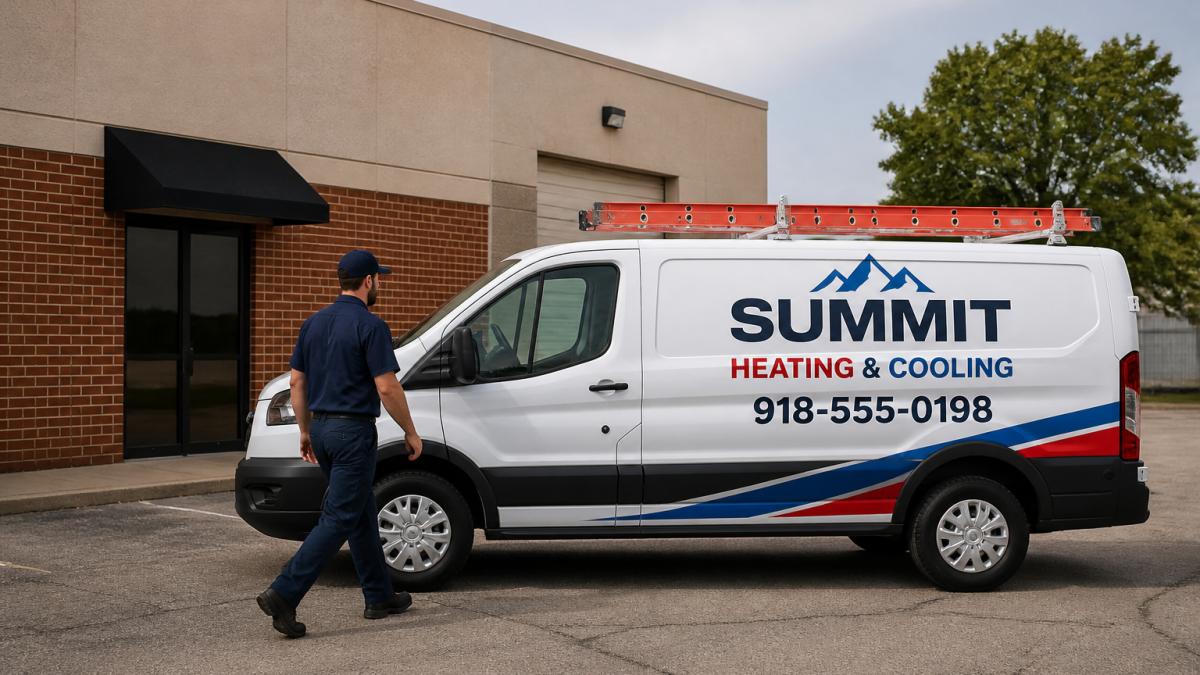
The design principles we apply to every fleet:
- High contrast. Dark text on light panels or the reverse. Never gray on gray.
- Legibility over cleverness. A readable sans-serif beats a stylized script every time.
- Company name and logo placement. Front doors and the rear get seen most; put your identity there.
- Contact information and a call to action. Phone number large enough to read in traffic, plus a short service line.
- Consistent branding across the fleet. Same colors, layout, and placement on every vehicle so the fleet reads as one company.
- Clean design. Negative space is your friend. Cluttered panels read as noise.
A common mistake is designing on a computer screen at full size. Shrink the layout to thumbnail size and check it. If you can’t read the name and number, neither can a driver in the next lane.
How to Read Fleet Branding ROI Without Guesswork
Fleet branding ROI is measured by tracking how customers find you, not by counting impressions you cannot verify. Build attribution into the graphics themselves, then review the numbers on a schedule.
Build attribution into the design. Before the vinyl goes on, decide how you will know a call or visit came from the vehicle. Three mechanisms do most of the work:
- A dedicated tracking number. A separate phone line printed only on the fleet means every call to that number is attributable. Route it to your main line or a call-tracking service so nobody misses it.
- A QR code or short URL. A QR code on the rear panel pointing to a fleet-specific landing page captures scans and shows which vehicles and routes drive traffic. Use a short, memorable URL for people who will not scan.
- An intake question. Add “How did you hear about us?” with vehicle graphics as an option on your intake form or booking page to capture customers who saw the truck but did not use the tracked number.
Log the baseline before installation. Record average monthly calls, form submissions, and booked jobs for the two to three months before the graphics go on. Without a baseline, you cannot tell whether a busy month is the wrap or the season. Keep the same measurement for the first six months and compare month over month.
Use a simple scorecard. Once a month, log four numbers: tracked calls, QR or landing-page visits, “saw the truck” intake responses, and jobs booked from those sources. A common pattern is a slow first month, a steady climb through months three to six, then a plateau as recognition saturates your routes. If numbers stay flat after six months, the problem is usually design legibility or route coverage, not the channel.
Ask customers directly. A short survey question at job completion (“Where did you first see us?”) catches the word-of-mouth and drive-by recognition that tracking numbers miss.
The thing nobody tells you about fleet branding ROI is that it compounds. Recognition builds slowly, then customers start calling because they have seen the truck a dozen times.
Commercial Vehicle Wrap Lifespan and What Shortens It
Commercial vehicle wrap lifespan typically runs several years with quality materials and proper care, but installation quality and maintenance decide whether you get the long end of that range.
What shortens a wrap’s life:
- Cheap calendared vinyl that shrinks and lifts at edges.
- Poor surface prep before installation, the number one cause of early failure.
- Hand washing with harsh chemicals or pressure washing too close to edges.
- Long-term sun exposure without a quality laminate for UV protection.
- Improper storage in extreme heat or cold.
The prevention side is straightforward: wash gently, park in shade when you can, and fix small lifts before they spread. Our guide on how to prevent vehicle wrap peeling covers the care details that extend life.
Ask what warranty backs the material and the install. We partner with Arlon, 3M, and Oracle, and we provide the strong manufacturer warranties associated with those partnerships.
Permits, Leases, and Insurance Rules to Check First
Rules vary by state and locality, and commercial signage restrictions are typically handled at the state and municipal level.
Lease and financing restrictions matter just as much. Many lease agreements prohibit permanent modifications, and while quality vinyl is removable, some contracts still require written approval.
For insurance, a wrap generally doesn’t change your coverage, but notify your carrier anyway.
Watch out: skipping the lease check is the expensive one.
Getting Your Fleet Graphics Quote from Outlaw Kustomz
A good quote starts with your vehicle, your routes, and your budget, not a price list. That’s how we approach every small fleet, whether it’s two service vans or a mixed fleet of trucks and trailers.
Here’s what to have ready when you call:
- Vehicle makes, models, and years
- How many vehicles now, and how many you expect to add
- Your logo and any existing brand assets
- A rough coverage preference: lettering, partial, or full
- Your timeline and how long any vehicle can be off the road
We handle design, printing, and installation in our climate-controlled facility. Our team brings over 30 years of combined industry experience, backed by manufacturer warranties through Arlon, 3M, and Oracle.
Most small businesses delay branding their vehicles because they assume it’s a big-fleet expense. Get started with Outlaw Kustomz and put the vehicles you already own to work as advertising. Contact us to book your quote or call (918) 810-3929.
Frequently Asked Questions
Are fleet graphics worth it for a small business?
For most small service businesses, yes. Fleet graphics turn vehicles you already drive into mobile advertising that works during every service call. The cost is paid once, while the exposure repeats daily across your service area. The key is matching the investment to your fleet size and route density. A two-truck operation can start with partial graphics on the doors and rear panels, then expand coverage as revenue allows.
What drives the cost of commercial vehicle graphics?
Coverage level, vehicle size and shape, design complexity, and material grade all affect the cost. A partial wrap on a van costs far less than a full wrap on a box truck because it uses less vinyl and less installation labor. Removal of old graphics, surface condition, and window coverage also affect the quote. Pricing depends on your vehicles and coverage, so request a quote from Outlaw Kustomz for current pricing.
How long do commercial vehicle graphics last?
Commercial vehicle wrap lifespan depends on material quality, sun exposure, and maintenance. Manufacturer warranties vary by film line, so ask which film and warranty apply to your job. Hand washing with mild soap and avoiding pressure-wash blasts at seams extends life. Outlaw Kustomz backs installations with manufacturer warranties through partners including Arlon and 3M, so ask which film and warranty apply to your job.
Can fleet graphics go on leased vehicles?
Usually yes, with conditions. Most leases allow graphics if they are removable without damaging paint, but you should check your lease agreement before ordering. High-quality cast vinyl removes cleanly from factory paint when installed and removed properly. Avoid covering damage you would be charged for at turn-in, and keep removal in mind if your lease ends soon.
How do I measure fleet branding ROI?
Track what you can control: calls from your vehicle number using a dedicated tracking line, quote requests mentioning they saw the truck, and website visits from your service area. Compare monthly lead volume before and after graphics go live. Because vehicle graphics keep working without per-impression cost, the return grows the longer you keep the vehicle on the road. A simple log of new-customer sources for the first 90 days gives you a practical baseline.
What information should go on a business vehicle?
Keep it to what a potential customer needs at a glance: company name, what you do, a phone number large enough to read at highway speed, and your website. Add a license number if your trade requires one. Skip long service lists and small print, which are unreadable in traffic. High contrast between text and background matters more than decorative detail. One clear call to action beats five competing messages on a single panel.
