
Last Updated: October 28, 2026
Quick Summary
Preventing vehicle wrap peeling starts with thorough surface preparation: wash, wipe with isopropyl alcohol, and clay bar every panel so adhesive bonds to clean paint. Keep stretch within the film’s working range and post-heat every edge and high-stress area to lock the bond.
- Dirt, grease, wax residue, or silicone under the film blocks adhesive from touching paint.
- Overstretching is the single most common installation error, since stretched vinyl tries to return to its original size.
- Cast film conforms to complex curves with less tension, while calendared film tends to fight tight curves.
- Hand wash with mild soap and a soft mitt, and never aim a spray nozzle directly at an edge.
- Film applied before new paint fully cures traps escaping solvents that push the adhesive off the panel.
Table of Contents
- Why Vehicle Wrap Peeling Happens in the First Place
- Surface Preparation: The Step That Decides Whether Your Wrap Sticks
- Vinyl Wrap Installation Tips That Stop Peeling Before It Starts
- How to Wash a Wrapped Car Without Loosening the Edges
- How to Fix Peeling Vinyl Wrap: Repair or Replace?
- Material Choice and Paint Condition: What Determines Longevity
- A Prevention-First Checklist for Your Next Wrap
- Book a Climate-Controlled Installation at Outlaw Kustomz
- Frequently Asked Questions
Why Vehicle Wrap Peeling Happens in the First Place
Vehicle wrap peeling can have several causes, including a weak bond between vinyl film and paint. Understanding potential causes can help with prevention.
The Four Causes Behind Lifted Edges and Bubbles
Potential causes of lifted edges and bubbles include:
- Contamination under the film. Dirt, grease, wax residue, or silicone left on the panel blocks the adhesive from touching paint.
- Moisture trapped at the edge. Film applied before the surface dries completely will lift as water works its way out.
- Overstretching the vinyl. Film stretched past its limit pulls back toward its original shape and lifts at corners.
- Weak post-heating. Edges that never reach the right temperature never fully bond, so they fail under sun and wash cycles.
Surface Preparation: The Step That Decides Whether Your Wrap Sticks
Surface preparation removes contamination from paint so adhesive can bond. Poor preparation can contribute to peeling.
Start with a clean surface and work in a controlled space. Dust and airborne debris will land on wet panels and get locked under the film.
- Wash the vehicle with a mild soap to strip loose dirt.
- Wipe down each panel with isopropyl alcohol to remove oils and wax.
- Use a clay bar on painted surfaces to pull embedded contamination.
- Dry completely, then inspect under bright light before any film touches the panel.
- Re-wipe edges and recessed areas right before application.
Cleaning Edges, Recessed Areas and Tight Corners
Edges and recesses can collect contamination. If those areas are not clean, the film may lift there.
Let the surface dry completely before applying film.
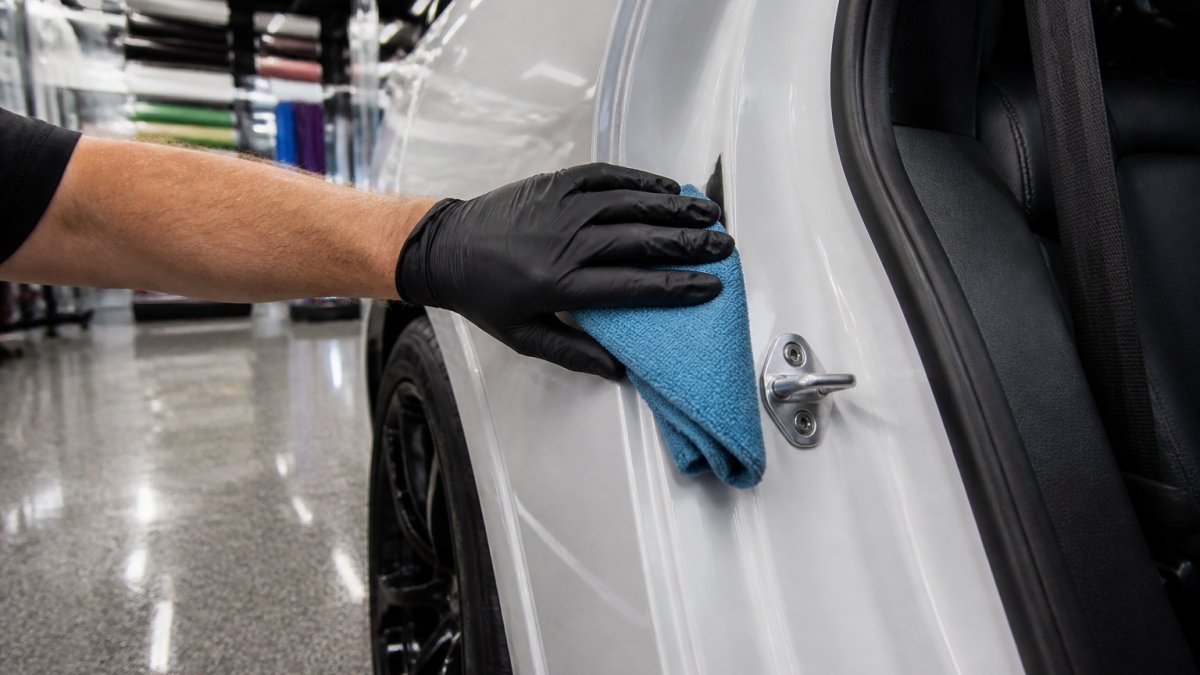
Vinyl Wrap Installation Tips That Stop Peeling Before It Starts
Installation involves factors such as stretch and heat. Follow the film manufacturer’s guidance for the specific product.
Stretching, Heat and Post-Heating Specifications
Overstretching is the single most common installation error. Vinyl has a memory, and stretched film tries to return to its original size. That pull is what lifts corners and curves. The fix is not to avoid stretch entirely, complex curves require it, but to keep stretch within the film’s working range and to lock the result with heat.
- Set the film, don’t force it. Use a squeegee to lay film flat before you reach for heat. Heat relaxes film; it does not replace proper squeegee technique.
- Stretch only as much as the curve demands. Work from the center of a panel outward so excess film moves to the edges rather than bunching at a corner.
- Heat evenly and keep the gun moving. A concentrated hot spot warps or glosses the film. Sweep the heat gun across the area rather than holding it in one place.
- Post-heat every edge and high-stress area. Edges, recesses, and stretched zones need a controlled heat cycle after application to fully activate the adhesive.
Post-heating is one installation factor discussed in some film manufacturers’ guidance. Follow the instructions for the specific product. See how Outlaw Kustomz creates stunning vehicle wraps in Tulsa, OK.
Match Heat and Stretch to the Film Type
Film construction changes how much heat and stretch a panel will tolerate. Cast film is poured on a liner and conforms to complex curves with less tension, so it holds edges longer on mirrors, bumpers, and recessed areas. Calendared film is manufactured under pressure, costs less, and tends to fight tight curves, which means more stretch and a higher risk of pull-back if edges are not post-heated carefully.
3M’s vehicle wrap installation guidance covers film handling and heat recommendations by product line, and it is worth reading before any install.
How to Wash a Wrapped Car Without Loosening the Edges
Hand washing is one way to clean a wrapped vehicle. Avoid directing high-pressure water at edges.
- Hand wash with mild soap and a soft mitt.
- Avoid pressure washing near edges, seams, and recessed areas.
- Never aim a spray nozzle directly at an edge.
- Dry with a soft microfiber towel; do not let water sit at seams.
- Skip automatic brush car washes entirely.
For a deeper walkthrough of ongoing care, our guide on how to maintain vehicle wraps covers edge sealing and long-term upkeep after washing.
How to Fix Peeling Vinyl Wrap: Repair or Replace?
Whether a lifted wrap can be repaired or needs replacement depends on the condition of the film and the surface beneath it.
Material Choice and Paint Condition: What Determines Longevity
Film quality and paint condition set the ceiling on how long a wrap lasts. A quality cast vinyl from a reputable manufacturer outperforms cheap calendared film on curves and edges every time. But the film is only half the bond, the surface it is applied to decides whether the adhesive can hold at all.
How Paint and Substrate Condition Affect Adhesion
- Fresh paint that has not fully cured. Solvents continue to escape from new paint for weeks. Film applied too soon traps those solvents, and the outgassing pushes the adhesive off the panel. Most paint manufacturers publish a cure window before wrapping; respect it rather than guessing.
- Failing or peeling clear coat. If the clear coat is lifting, the film will bond to the clear coat, and then take it with it when the wrap is removed or when the panel flexes. Wrapping over failing clear coat hides the problem temporarily and makes it worse later.
- Oxidized or chalky paint. Oxidation leaves a powdery surface layer that adhesive cannot grip. It has to be corrected before film goes down.
- Repainted or bodywork panels. Repairs, blend lines, and aftermarket paint can behave differently from factory finish. Inspect these panels closely and confirm cure and adhesion before wrapping.
- Contamination that prep missed. Wax, silicone, and polishing oils sit in the pores of the paint and block the adhesive. An alcohol wipe and clay bar pass is not optional on a panel with unknown history.
Diagnose the Cause Before You Repair
| What You See | Likely Cause | What to Check |
|---|---|---|
| Lift at edges and recesses with grit underneath | Contamination under the film | Prep sequence, edge cleaning, alcohol wipe before application |
| Bubbles or lift near seams and jambs | Trapped moisture | Surface dryness before film, application fluid left at edges |
| Corners pull back toward the panel center | Overstretching | Stretch amount on that curve, film type versus curve complexity |
| Edges lift in sun or after washing | Weak post-heating | Whether the edge reached the film’s post-heat range |
| Lift across a broad panel with no grit | Substrate failure or outgassing | Paint cure, clear coat condition, repaint history |
If you are still weighing installers, our guide on finding a quality car wrap shop explains what to check before you commit.
| Cause of Peeling | Warning Sign | Fix | Prevention |
|---|---|---|---|
| Contamination | Lift at edges, grit under film | Clean and reseal edge | Alcohol wipe and clay bar before install |
| Trapped moisture | Bubbles near seams | Dry and reapply | Dry completely before film |
| Overstretching | Corners pull back | Replace film section | Stretch only as needed |
| Weak post-heating | Edges lift in sun | Reheat and reseal | Post-heat every edge |
| Substrate failure | Broad panel lift, no grit | Correct or decline the wrap | Confirm paint cure and clear coat condition |
A Prevention-First Checklist for Your Next Wrap
- Wash and degrease every panel
- Wipe with isopropyl alcohol and let dry
- Clay bar painted surfaces
- Clean edges, jambs, and recessed areas
- Confirm the space is clean and climate-controlled
- Stretch film only as much as the curve requires
- Post-heat all edges and high-stress areas
- Hand wash only, and keep pressure washers away from edges
Book a Climate-Controlled Installation at Outlaw Kustomz
Our 8,000 sq. ft. climate-controlled facility supports our vehicle wrap services.
We offer manufacturer warranties through partnerships with Arlon, 3M, and Oracle. Our team brings 30+ years of combined experience, and we handle design, printing, and installation.
Ready to protect your investment? Explore our full vehicle wrap services to request a quote, or contact our team.
Frequently Asked Questions
What causes a vehicle wrap to peel?
Vehicle wrap peeling can have several causes. Follow the film manufacturer’s care and installation guidance.
How should you wash a wrapped vehicle to prevent peeling?
For care guidance, follow the film manufacturer’s instructions.
Can peeling vinyl wrap be repaired, or does the whole panel need replacing?
Whether a lifted wrap can be repaired or needs replacement depends on the condition of the film and the surface beneath it. Contact a qualified wrap professional for an assessment.
How long do vehicle wraps last when installed and maintained properly?
Wrap longevity and warranty coverage depend on the specific film and project. Contact the installer for details about the applicable manufacturer warranty.
Peeling is preventable, but only when prep, stretch control, and post-heating are treated as non-negotiable. If you want a wrap that holds its edges through sun, rain, and wash cycles, get started with Outlaw Kustomz and book a climate-controlled installation built to last.
